There’s something oddly liberating about being clueless.
We’re conditioned to chase mastery — collect degrees, stack skills, and stay on top of our game. But there’s a quieter joy in starting from scratch, in not knowing, in fumbling your way forward. Being a beginner, voluntarily or otherwise, puts you back in touch with something raw and alive.
I’ve come to see beginnerhood not as a weakness, but as a kind of quiet strength. When you’re a beginner, the world regains its texture. Every small success — tying a clean yoga bind, painting your first awkward watercolour flower, configuring a basic Python script — feels like a personal revolution. There’s no expectation to be perfect. Just the permission to be curious.
A Personal Note from the Beginning Line
A few months ago, I opened Blender for the first time. The interface stared back like a cryptic puzzle. I’ve worked with complex models and AI frameworks — but this was something else. Alien.
Nothing I clicked made sense. I undid every step. I almost gave up.
But something made me stay. Maybe it was the freedom of not knowing what to expect. Maybe it was curiosity unshackled from performance.
Frame by frame, I figured things out. I made ugly objects. The render crashed. But that moment, that disorientation — it felt strangely nourishing.
I wasn’t producing. I was learning.
“In the beginner’s mind there are many possibilities, but in the expert’s mind there are few.” — Shunryu Suzuki
Why Beginnerhood Matters (Especially Now)
We live in a world obsessed with speed and perfection. But being a beginner is an invitation to slow down. To notice details. To get intimate with the process, not just the outcome.
When we start something new — a language, a skill, a city — we return to asking better questions. We listen harder. We drop the mask of certainty. And slowly, quietly, we stretch into who we’re becoming.
What I’ve discovered is this: being a beginner doesn’t make you smaller — it stretches you. It reminds you that learning is not a ladder to be climbed but a field to be wandered, barefoot and wide-eyed.
In a way, that’s more powerful than being the expert in the room.
Lessons from the Blank Page
Here are a few truths I’ve come to love about being a beginner:
You stop performing and start absorbing. You don’t have to prove anything — which is exactly when real learning begins.
You build resilience gently. Every mistake becomes data, not defeat.
You remember what empathy feels like. You’re kinder to yourself — and by extension, to others finding their footing too.
Time feels different. There’s presence. Attention. A kind of flow in the fumbling.
From PhD Walls to Swim Lanes
This isn’t just about creative tools.
During my PhD, there were long phases of uncertainty, where nothing made sense, where I questioned everything. But looking back, that discomfort was doing the slow work of reshaping me. Teaching me to stay. To ask again. To try, even when I didn’t know how it would unfold.
Later, I took swimming lessons as an adult. Humbling? Absolutely. But in the embarrassment, there was a strange joy. I wasn’t competing. I was just showing up. Breath by breath, stroke by stroke.
“You have a right to your actions, but never to your actions’ fruits.” — Bhagavad Gita
This line hits differently when you’re learning something from the ground up.
An Invitation
In a world obsessed with speed, scale, and showing off — to begin again is an act of quiet rebellion.
Where in your life can you start over? What’s something you’ve shelved because you didn’t want to be seen starting small?
Dust it off. Begin again.
There’s beauty in the slowness. Grace in the mess. And, quietly, your future self is cheering you on.
So here’s to the fresh notebooks. The trembling first strokes. The teachers we find in strangers, children, and YouTube tutorials. Here’s to stumbling and laughing and asking the obvious questions.
Because sometimes the most soulful progress begins when we stop trying to prove, and start choosing to play.
✨ If this resonates, I’d love to hear from you. Drop a note or comment — what are you learning or relearning right now? Let’s celebrate the courage it takes to begin.
Resilience used to feel like a word made of steel — cold, rigid, unbending. I imagined it as something you grit your teeth to build, something you summoned in hard times like a shield. You pushed through. You soldiered on. You kept going because that’s what strong people do.
But lately, I’m learning that real resilience isn’t forged in resistance. It isn’t always bold or loud or Instagrammable. Sometimes it’s the quiet decision to not give up on yourself — again.
Sometimes it’s a whisper, not a roar.
Over the past few months, life has delivered its usual mix of curveballs, cosmic nudges, and unanswered questions. Things I thought would come through didn’t. Opportunities shifted. The ground beneath what felt certain, moved. And in that movement, something inside me cracked open — not in despair, but in a strange kind of softness.
I’ve started to realize that resilience isn’t the ability to bounce back to who you were before. It’s the grace to become someone new, someone gentler, someone who can carry the learnings forward with more love.
It’s in those mornings when the world feels heavy and yet, you choose to make your bed anyway. It’s in the art of reaching for poetry when your mind wants to spiral. It’s in replying to an email even when your spirit feels porous. It’s in drinking water, stretching, and forgiving yourself for needing rest.
Resilience, I’ve come to believe, is a rhythm — not a race.
It lives in the mundane. In routines that look ordinary on the outside but hold the scaffolding of your becoming. It lives in the way you start again — for the sixth or sixteenth time. It lives in how you allow grief and gratitude to coexist in the same breath.
I’m learning to not measure resilience by productivity. I’m learning to honor my pauses — the days when my mind needs stillness, the afternoons when I sit in silence without needing to name or fix. In these moments, resilience feels like surrender. Like trusting that something is being woven inside the stillness, even if I can’t see it yet.
One of the most surprising lessons has been this: resilience is not always about strength. Sometimes, it’s about tenderness. It’s about how kindly you speak to yourself in the aftermath of disappointment. It’s about how slowly you allow yourself to heal. It’s about not rushing your bloom.
We don’t talk enough about emotional fatigue — that bone-deep exhaustion that doesn’t come from doing, but from feeling. The exhaustion of hope deferred. The fatigue of carrying invisible burdens. The quiet ache of holding space for your own becoming while still showing up for others.
But even here, in the ache, resilience is quietly working. Not in transformation with trumpets, but in quiet cellular shifts — in the realignment of what you now allow, what you no longer chase, what you choose to honor.
I’m also learning that resilience isn’t solitary. It’s not about doing it all on your own. It’s about the friends who text “thinking of you” out of nowhere. It’s about leaning into shared laughter, asking for help, or letting someone hold space for your tears without rushing you back to joy.
It’s about community — even if that community is one person who sees you clearly.
Resilience, at its core, is a love story. A long, unfolding letter to the parts of you that once doubted they could survive — and now are slowly learning to thrive.
It’s in the ink you spill when you write through confusion. It’s in the tea you brew for yourself like a sacred act. It’s in the small ceremonies of coming home to your own heartbeat.
I don’t have it all figured out. Most days, I’m still piecing together what it means to hold ambition with ease, to stay tender in a world that rewards hard edges, to choose peace without guilt.
But I’m learning.
I’m learning that resilience is not a performance. It’s not about being unshaken. It’s about being willing to be reshaped.
So if you’re reading this and feel tired — not just physically, but soul-tired — I want you to know: you’re not failing. You’re growing. Even in your stillness. Especially in your stillness.
Let’s reclaim resilience as something rooted in love, not pressure. Let’s measure it by how well we return to ourselves — not how quickly we recover.
Because ultimately, the strongest people I know are not the ones who “bounce back” with polished smiles. They’re the ones who return softer, wiser, more tender — and still willing to believe in light.
I used to chase inspiration like a butterfly — darting from one idea to another, waiting for something “big” or “worthy” enough to write about. But over time, I’ve come to realize that ideas don’t always arrive with fanfare. They often whisper, not shout. And almost always, they hide in plain sight.
Inspiration doesn’t need an occasion. It slips into morning light filtered through old curtains. It echoes in overheard conversations at cafes, or in the pause between two songs you didn’t realize you needed. Sometimes it’s in the quiet — the kind that presses gently against you when you walk alone, phone forgotten, thoughts wandering.
I once found an idea while watching my father quietly rotate a tyre at his workshop — hands covered in grease, mind somewhere far away. It wasn’t about machines. It was about rhythm. Repetition. Intimacy. How craft is love made visible. That became a thread I tugged at, and it led to an essay on why the work we do with our hands is often more honest than the words we speak.
Inspiration lives in the mundane. The chipped cup you refuse to throw away. The moment your bus stops in traffic and you lock eyes with a stranger who smiles. That sudden memory of a song your mother hummed while folding clothes. All of these — little things — ask for our attention. And when we give it, they open like portals.
At MangoSoul, I hope to collect these small portals. To write not just when I feel profound, but especially when I feel ordinary. Because that’s where the soul speaks clearest — in the quiet, everyday spaces we forget to look.
So here’s to soft ideas, slow moments, and the beauty of the barely noticed.
Some mornings, I find myself out of breath when I wake up.
It is the result not of running, but of the invisible race that begins the minute the world wakes up— inboxes, deadlines, notifications, and more.
The pace we live at is a very strange sprint. Everybody is moving, creating, and updating. And in all that haze, it can be easy to forget the little anchoring details that give life its depth — the taste of tea sipped at a leisurely pace, the long shadow of a 4 p.m. sun, the simple comfort of finishing a thought before rushing on to the next.
This post is not about doing less. It’s the doing with presence that counts.
It’s about prioritizing depth over speed, stops over pings, and soul over schedule.
Slowness isn’t laziness. It’s clarity.
I used to think slowing down was indulgent—a luxury for those with more time and less ambition. But I have since learned that slow living is not the absence of movement: It’s the presence of intention.
And, when I do slow down long enough to walk without my phone or write with no reason except to hear myself think, I notice things. I notice how people tilt their heads when they’re listening, the way my thoughts soften when I’m not fighting them, I notice the sound of silence.
Slowness is what brings me back to myself. It clears the fog.
The world will not wait — but you can.
What I’ve discovered is this: the world doesn’t slow down, but you can choose to. Even briefly. Even imperfectly.
Slow living is not a consistent state. It’s a decision that gets made minute by minute. It’s the decision to break away from a sense of urgency and say, “What really needs my energy right now?”
Maybe it’s just one meaningful conversation.
Perhaps it’s the end of reading a book, not the skimming through of three.
It could be by doing one thing with absolute, immense fervor rather than five things with mild enthusiasm.
Some of the ways I incorporate slow living (when I remember to)
Writing longhand. No editing, no undo button. Just letting words flow.
Going for long quiet walks, no music, only breath.
Drinking tea like it matters. Because it does!
Deciding to call, not text, when I want to really listen to someone.
Allowing the day to conclude without accomplishing everything. And being okay with that.
It’s not escaping the world. It’s also about staying whole in it.
Fast isn’t always bad. But when fast is all we have, we forget how to rest, how to listen, how to live with feeling.
Slow living is a small act of rebellion in a world that rewards burnout. It’s not glitzy or productive in the way we are used to measuring things. But it feeds something deeper.
And in that quiet nourishment, we find our way back to ourselves.
Perhaps you’re reading this during a hectic day. That’s okay. You paused. You’re here. That’s already enough.
Mangosoul was a silent vow to myself, a place to slow down, to take note, and to collect thoughts and feelings that often get caught in the dregs of daily life.
At some point we decided that we want to be alive and aliveness is louder than being dead. Other dreams took shape. This space waited, I felt, patient and unfinished, like a handwritten letter I hadn’t mailed yet.
Today, I return. Not with grand plans or polished blueprints, but with the humble commitment to get started. To write a little, notice a little, listen more closely to the small voice within — the one that doesn’t speak in metrics or deadlines, but in moments and meaning.
If all goes well, Mangosoul will develop into a journal of reflections about creativity, resilience, and the unseen art of just being alive. The posts will not always be perfect. These may feel more like quiet sketches than declarations. And that’s okay.
If you’re here — welcome. I’m so blessed that our paths have crossed.
I hope you find something here that resonates with you, or triggers a thought, or just makes you stop for a second.
Thank you for being with us as we embark on this fresh start. 🌿
Stop interrupting what people are interested in and be what people are interested in.
Craig Davis
The customer does not buy the product, but the story. The importance of storytelling has always been important for us, homo sapiens. What you say is important, but how you say it is where the secret lies. This article will discuss the science of marketing and the growing usage and impact of technology in the domain.
Overview of the article:
The fundamentals of marketing
The art of storytelling
Traditional vs. Digital Marketing
Technology as an enabler
CATT Marketing Funnel and Framework
Integrated Digital Marketing Framework
Personal Branding: MassTrust Blueprint
Conclusion
Defining Marketing
Marketing is not a function, it is the whole business seen from the customer’s point of view.
Peter Drucker
In July 2013, American Marketing Association published the official definition of marketing as: “the activity, set of institutions, and processes for creating, communicating, delivering, and exchanging offerings that have value for customers, clients, partners, and society at large. ”
The above definition lists out the various parameters of marketing, but let us look at some points in order to understand better.
Marketing starts before creating the product or service to develop an understanding of the customer’s needs and wants.
It is all about timing; the right person should be targeted in the right way and at the right time.
When the philosophy (derived from the mission statement) and implementation of available technology are in line with the rest of the business, marketing is the most successful in this scenario.
Word of mouth is the best marketing channel. In this age of information overload, people tend to trust the reviews of other people more. Especially if those people are friends and family.
The aim of marketing is to find and keep customers. The existing customers need to be kept happy so that they can be customers for life.
The art of Storytelling!
Writing and other forms of data storage and processing systems were developed much later by homo sapiens. Before that, the knowledge was passed from generation to generation orally in the form of stories. The great Indian epics of Ramayana and Mahabharatha were also passed on as stories for many generations. Thus, it is a fact that our brains have evolved to love stories!
Marketing is rooted in human psychology. Emotions are a big part of our lives, whether we like to acknowledge them or not. Most of the time, customers buy experiences and not products! Storytelling in marketing uses a narrative to communicate to the consumers and inspire them to take action.
The motive of storytelling is to make the consumers feel connected to the brand and help them understand why they should care about something. Moreover, storytelling is not limited to a particular mode of communication. Stories can be told via movies, pictures, verbally, through writing, basically howsoever one decides to tell it. Regardless of age, an authentic story always catches attention and sticks!
Recently, Coca-Cola augmented reality in an innovative campaign. When the customer pointed the phone camera at a coca-cola can, one of 12 stories came to life. Each of these stories features animated characters that engage in a minor conflict before they find a positive solution, which revolved around sharing a can of Coca-Cola.
Today we have technology at our disposal but the power of a simple story is unprecedented. Storytelling equips brands to communicate value in a way that needs no explanation.
Traditional vs. Digital Marketing
The major point of difference between traditional and digital marketing is the medium of communication to the audience. Traditional marketing mediums, such as television, magazines, newspapers, and hoardings have a wide reach. One of the disadvantages of traditional marketing systems is that you cannot personalize the communication. Digital communications are more customized as per the users of a particular social media platforms or websites.
Traditional marketing still plays a crucial role in people’s lives, especially with the ever-increasing need to step out of the digital world. If we are marketing for a generic product with a vast targeting audience, television advertisements can cost-effectively reach millions.
On similar lines, digital marketing uses every possible way to reach you while you use the internet. Most people these days use the internet for several hours each day. Digital marketing uses this to its advantage by incorporating tailored marketing communications across various digital channels.
It is easy to measure the results of digital marketing efforts in comparison to the traditional marketing. Also, every potential customer can be targeted in a very intelligent way. The consumer would feel as if the marketing communication is specifically directed to him/her only. It would feel more personal. These techniques are constantly evolving and require continuous efforts from the digital marketer. Traditional advertisements are more impactful, memorable, and permanent in nature.
In short, it all boils down to the specific marketing needs, budget, and target audience. Both traditional and digital marketing would work for you if you do what your audience needs.
Technology as an enabler
Marketing ecosystems are becoming more integrated and targeted in nature. Technology has helped marketers to scale personalization in their campaigns. The interface between brands and people has been transformed, and so has the very infrastructure and foundations on which the companies are built. Technology is also aiding to be a tool for better communication due to the increase in chatbots’ adoption.
The key point to remember here is that technology is still an enabler and not a strategy.
Technology doesn’t solve humanity’s problems. It was always naive to think so. Technology is an enabler, but humanity has to deal with humanity’s problems.
Sundar Pichai
Having a customer-centric approach is crucial. The main objective of marketing is to communicate to the customer how does a product/service aim to solve their problem effectively. Technology can help us to communicate that to the customer but it cannot do so on its own.
CATT Marketing Funnel and Framework
This framework helps to establish a personal brand and business for digital marketing. For 1:1 sales, the AIDA framework is mostly used where A is Attention, I is Interest, D is Desire, and A is Action. The salesman consciously or subconsciously follows the framework when executing the marketing communication strategy. Digital marketing, on the other hand, needs a mass-trust system in place. That is where the CATT framework comes into the picture.
Wealth= n^CATT
where
[n] Niche: Your Success & Wealth depends on the niche (area of expertise: an overlap of passion, talent, and market opportunity) that you choose
[C] Content: Create useful content that attracts people from your niche—blog posts, videos, lead magnets, live webinars, etc.
[A] Attention: Drive attention(traffic) to your content using SEO, Social Media, Paid Ads, and Referrals.
[T]Trust: Build trust with your audience with tripwires, marketing automation, and re-targeting.
[T]Transaction: Convert your leads into customers with natural sales methods
CATT framework helps to scale trust in the digital marketing domain. The cycle would overall drive the business forward and can be expanded across evolving niches.
Integrated Digital Marketing Framework
Integrated digital marketing is a method of engaging customers and prospects with your company or brand that combines all parts of marketing communications to work together and assist the customer along their journey of awareness to loyalty and advocacy.
The Data & Marketing Association
Digital marketing strategies usually need all the channels, media, and tools working in tandem to fulfill the customer needs.
Integrated Digital Marketing Framework is the engine that drives the CATT funnel. In the CATT funnel, we may have customers at different stages of the funnel and when we look at all of them together, we see the integrated framework! It is like a team synergy that achieves more than the total of the capacities of all its members when working synchronously.
The potential customer is attracted through paid advertising towards the free content. In the process, their email id is also asked for. Then, whenever a new article is published, or new content is added, they receive an email. Simultaneously, people may search for content, and through the search engines, may arrive at the content. The link to content can also be shared over social media platforms, and people may come to the platform. Through all the above processes, trust is built in the customers over a period of time, and then they may be sold premium services, and the transaction can be made.
Thus, the integrated digital marketing framework utilizes the strengths of several technologies available in an effective manner.
Personal Branding
People like to hear from people and not from brands. Also, people will listen to you only if they know you and trust you. This is the reason why building a personal brand is crucial. A personal brand becomes an influencer and a brand ambassador for the subsidiary companies run by the person.
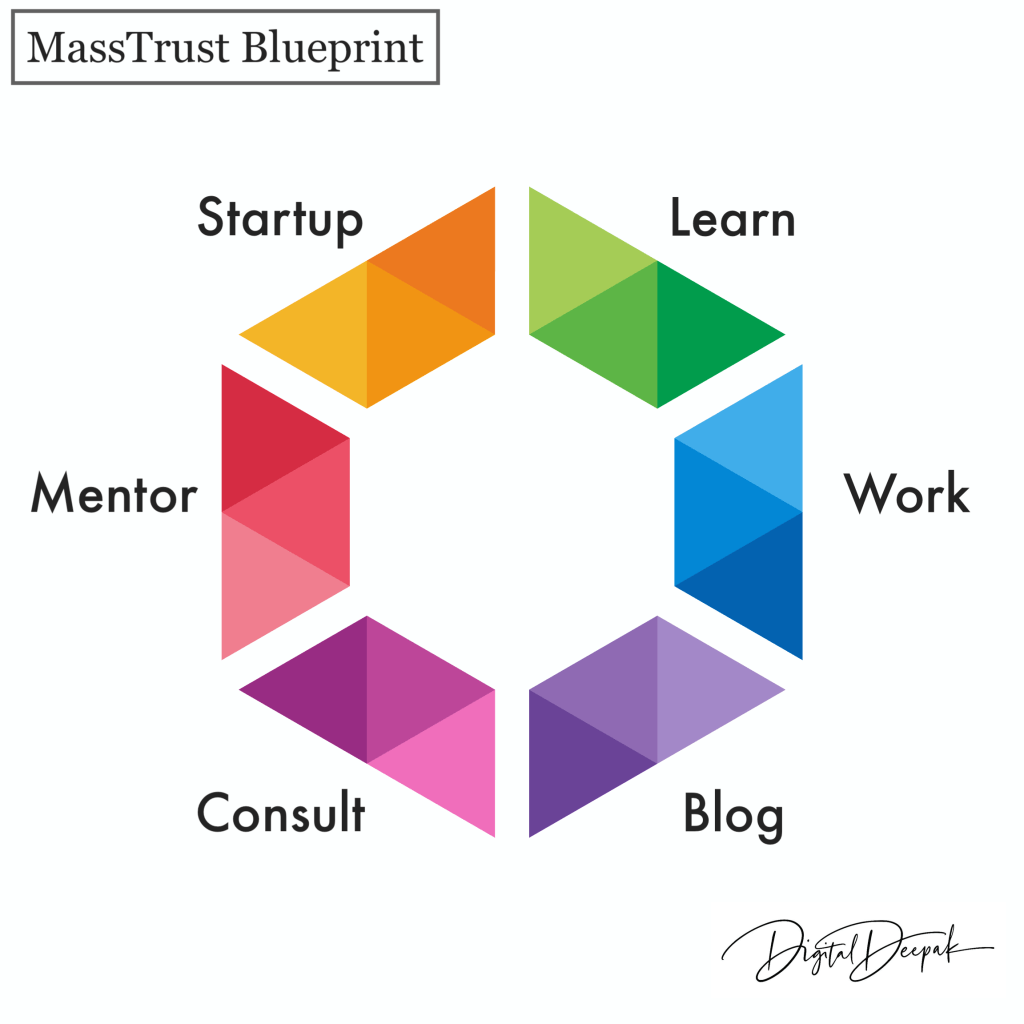
For the evolution of a personal brand, let us try to understand through the Mass Trust Blueprint:
Learn: Learn a new skill through Concepts, Facts, and Procedures. Understand the Concepts. Remember the facts and practice the Procedures.
Work: Put your new-found skill to work. Go from practice to implementation. Implementing it in the real world will give you a better understanding.
Blog: Write about what you have learned and experienced through your work. When you talk about your experiences with practicing your skill, your content becomes unique, and people would like to read it and learn from it. This would help you to start building your personal brand. You will also gain a better understanding of what you do.
Consult: When you have a personal brand through your blog, have work experience, and have a good understanding of the fundamentals, it is time to start consulting other businesses.
Mentor: Mentor others who aim to follow the same path as you. Mentoring will not only help others, but it will also help you to expand your understanding and skills.
Startup: With the understanding that you have developed regarding the skills, the market, and the problems, it is now time to start your own product or service business.
So, this is how a personal brand evolves. In the process of the evolution of a personal brand, we are actually aiming to build trust with a lot of people. Thus the name Mass Trust Framework. As we can see in the figure above, the framework is a never-ending circle. It would only help to continuously go through this evolution because it would help you to grow your personal brand. Learning is a never-ending process and all the other steps follow.
Conclusion
Digital marketing is more about “marketing” and less about digital. You need to start by dedicating yourself completely to one niche and be consistent. You should be the best at what you do!
The key is to continue to evolve. One should be ready to learn everyday, practice what you learn, and teach what you do in order to understand it better, and to do all of this over and over again.
Marketing takes a day to learn. Unfortunately, it takes a lifetime to master.
Philip Kotler
Thank you for taking time out to read till the very end. I hope you enjoyed and learnt a few new things today!
Do not forget to share your thoughts in the comments section!
References
Attest. 2020. 12 Top Storytelling Marketing Examples: How Brands Tell Stories | Attest Blog. [online]
Kanakaraju, D., Pavan, Rout, B., Deepak, Raveendrachary, Hussain, S., . . . Gaur, N. (2017, October 17). Content Marketing 2.0 – How to Plan and Execute an Integrated Digital Marketing Campaign. Retrieved December 23, 2020, from https://digitaldeepak.com/integrated-digital-marketing/
Ambica Ghai is an Indian businesswoman, computer scientist, investor, and writer. Her focus is on the application of AI and machine learning techniques for the betterment of society. She has co-founded and led Connect, whose main objective is to connect the latest AI research with applications. Ambica is also invited for guest lectures at leading universities and organizations.
In a recent interview, she discussed her latest venture, Balance, which focuses on using CBT techniques and the clients’ health data metrics to develop their treatment plan. She emphasizes the interconnectedness of physical and mental health.
On being asked about her take on the challenges in her path, Ghai says that the challenges that she faced in her life journey are solely responsible for whatever she has accomplished so far. She says that failures are great teachers. Success, as per her, is a very lousy teacher. When facing adversity, we do not have any other option but to act. In this process, we break our barriers and limits and thus, grow. This growth is the essence of life. Not every change is quantified, but every failure faced, in the long-term would increase our confidence in ourselves.
Talking about her upcoming initiative, Ambica hints that it is in the academic domain, and she is hopeful that it would improve the life of Indian researchers. She believes that the main objective of the research journey is to develop a growth mindset. We need to observe our surroundings, identify the problems society faces, and develop solutions to address those problems. Ghai further emphasizes that these problems and solutions need not be advanced. On the contrary, the simpler they are, the higher are the chances of adoption by society.
Being asked for her piece of advice for our readers, Ambica smiles and says, “Always remember, others opinion is not your description!”.
-Written by Saraswati Kapoor | Bangalore | Published: May 7, 2027 09:22 am
The year 2020 started with the messenger applications on my phone buzzing with wishes like:
May this year bring you the 2020 vision to focus on all essential aspects of life!
Anonymous, or Was that you?
2020 is the year that added so many terms to my limited medical vocabulary. The words that I was not even aware existed have now been overused to such an extent that I have started to detest them. It all began with unprecedented and then came along quarantine, lockdown, asymptomatic, carrier, contact tracing, community spread, and the list goes on and on.
Being a 90s kid, 2020 was like a symbolic marker of a futuristic decade for me, like the ones they show in sci-fi movies? And, in a way, it has been!
Like so many people around the world, I had my 2020 vision in place. It was supposed to be my year, where I would focus on my goals and achieve them. I am a full-time Ph.D. student, and hence uncertainty is a part of my life. But March 2020 was way beyond acceptable levels of uncertainty.
I always look at my thesis as a project and have a timeline in my mind. My biggest fear was to complete the work within the stipulated duration (actually, well before that, to be on the safe side!). What if I don’t? This was a question that gave me jitters!
And then, the global pandemic happened, and I had to come back home due to the indefinite lockdown. It took almost one month of trying to finally restart work because the show must go on. There were suddenly so many things to take care of without going out of the house. The levels of uncertainty were just beyond all imagined limits. But here is the plot twist!
Since the beginning of my Ph.D. program, I had dreaded working on my thesis from home, but I am doing it now. I have faced challenge after challenge, and I have adapted. 2020 has actually helped me grow exponentially. Whenever I felt low about not getting desired and quantitative results earlier, my seniors advised me to treat Ph.D. as a part of my life and not have my life revolving around my Ph.D.
I never truly understood how to do that until last month. I am sure that is the most significant achievement of 2020 for me.
This year, I have started to rediscover myself and my love for writing as well. I had almost forgotten about this blog, but now I am back!
I am yet to achieve the quantitative goals, but now I genuinely believe that I will. It is only a matter of time!
Ana woke up with a start and looked around, confused. She couldn’t comprehend for a few minutes whether she had woken up from a dream, or was this a dream? And then her eyes fell on the clock. It did not matter what was real and what was not anymore. She was running an hour late, and if she did not reach the office in 20 minutes, she would lose the pay for yet another day!
She somehow got ready and opened the door to leave but was not prepared for what lay on the other side of the door. Ana just stood there and looked around. She pinched herself and cried out loud. Is it possible for us to feel pain while asleep? Maybe she got her period, and this is a PMS nightmare of some sort? Whatever it was, something was wrong for sure.
Ana had attracted a suited man’s attention towards herself with her cry. He was standing on the other side of the sky, which should otherwise have been her building hallway. She lived on the ground floor, and the suited man was now crossing the sky road to reach her. Ana was scratching her head, unable to make sense of anything.
The suited man was standing in front of her now and blabbering something as if every day he had to explain some idiot about whatever this version crossover glitch was. From whatever little Ana could comprehend, given that she was desperately trying to keep herself steady on her own feet, the suited man was called Tanis. He was a damage control guy of sorts.
When Ana finally could concentrate on whatever this Tanis said, she gathered that there was some sort of a bug in the system. Her brain seemed to be overworked. She was thinking about the study about us living in a computer simulation that she had read about a few days back. But who was the creator? And then who created the creator? What about Tanis? Where and how did he come into the picture? Were there others like him?
Tanis seemed to have been reading her mind because there he was standing, simply smiling from ear to ear, God he is so cute! Okay, he blushed! He can definitely read minds, and Ana could not make herself stop thinking. Ana was feeling embarrassed now. Thankfully, Tanis decided to bring Ana out of her misery by politely acknowledging that this was all way too much information to digest all at once. He then suggested that she should sit and take a moment to process.
Meanwhile, he gave her a red pill and a glass of water. He explained it would help her relax. And that it indeed did, because Ana instantly felt all the thoughts silence themselves. The last thing she heard was Tanis telling someone that the situation had been taken care of and they can restart the system for the day.
And then the next moment, Ana felt a jerk and opened her eyes, confused. She was in bed and remembered fragments of a weird dream. She couldn’t comprehend what it was about and the other details. And then her eyes fell on the clock, and it was 8:40 a.m.
Well, yes it is indeed the very first program we write when we learn to code. I remember doing it in school back in 5th standard. The programming language then used was BASIC and I hardly wrote 5 to 6 lines for a 10 mark programming question.
Yes, I am yet another software engineer working at an MNC and unlike many people, am proud of it. I am facing struggles, of all kinds, but at the end we have to face our own struggles, like everybody else in this big world!
But my point is, that life is not supposed to be a battle, it is what we make it, it should be a happy song for everyone, irrespective of whatever one is going through. We are all humans, then why do we not understand each other and also that if we are facing our struggles, so is the other person. Imagine, if we humans understand the actual meaning of politics and keep it till that only, and learn to empathize with each other, the world would be such a beautiful place to be a part of!!
Life is most enjoyed in its simplest terms, what is the need to complicate it and then try to understand?
These are some of the questions which I am trying to understand. Its said that the solution of every problem is out there inside us. We need to find the answers by exploring ourselves. So here I am, as always ready to learn, explore and of course write !









 mangosoul