Stop interrupting what people are interested in and be what people are interested in.
Craig Davis

The customer does not buy the product, but the story. The importance of storytelling has always been important for us, homo sapiens. What you say is important, but how you say it is where the secret lies. This article will discuss the science of marketing and the growing usage and impact of technology in the domain.
Overview of the article:
- The fundamentals of marketing
- The art of storytelling
- Traditional vs. Digital Marketing
- Technology as an enabler
- CATT Marketing Funnel and Framework
- Integrated Digital Marketing Framework
- Personal Branding: MassTrust Blueprint
- Conclusion
Defining Marketing
Marketing is not a function, it is the whole business seen from the customer’s point of view.
Peter Drucker
In July 2013, American Marketing Association published the official definition of marketing as: “the activity, set of institutions, and processes for creating, communicating, delivering, and exchanging offerings that have value for customers, clients, partners, and society at large. ”
The above definition lists out the various parameters of marketing, but let us look at some points in order to understand better.
- Marketing starts before creating the product or service to develop an understanding of the customer’s needs and wants.
- It is all about timing; the right person should be targeted in the right way and at the right time.
- When the philosophy (derived from the mission statement) and implementation of available technology are in line with the rest of the business, marketing is the most successful in this scenario.
- Word of mouth is the best marketing channel. In this age of information overload, people tend to trust the reviews of other people more. Especially if those people are friends and family.
- The aim of marketing is to find and keep customers. The existing customers need to be kept happy so that they can be customers for life.
The art of Storytelling!
Writing and other forms of data storage and processing systems were developed much later by homo sapiens. Before that, the knowledge was passed from generation to generation orally in the form of stories. The great Indian epics of Ramayana and Mahabharatha were also passed on as stories for many generations. Thus, it is a fact that our brains have evolved to love stories!
When information is woven in the form of a story, it becomes far more memorable; studies have proven this hypothesis. In one of these studies conducted by psychologist Jerome Bruner, it was found that a fact woven into a story is 22 times more likely to be remembered.
Marketing is rooted in human psychology. Emotions are a big part of our lives, whether we like to acknowledge them or not. Most of the time, customers buy experiences and not products! Storytelling in marketing uses a narrative to communicate to the consumers and inspire them to take action.
The motive of storytelling is to make the consumers feel connected to the brand and help them understand why they should care about something. Moreover, storytelling is not limited to a particular mode of communication. Stories can be told via movies, pictures, verbally, through writing, basically howsoever one decides to tell it. Regardless of age, an authentic story always catches attention and sticks!
Recently, Coca-Cola augmented reality in an innovative campaign. When the customer pointed the phone camera at a coca-cola can, one of 12 stories came to life. Each of these stories features animated characters that engage in a minor conflict before they find a positive solution, which revolved around sharing a can of Coca-Cola.
Today we have technology at our disposal but the power of a simple story is unprecedented. Storytelling equips brands to communicate value in a way that needs no explanation.
Traditional vs. Digital Marketing
The major point of difference between traditional and digital marketing is the medium of communication to the audience. Traditional marketing mediums, such as television, magazines, newspapers, and hoardings have a wide reach. One of the disadvantages of traditional marketing systems is that you cannot personalize the communication. Digital communications are more customized as per the users of a particular social media platforms or websites.
Traditional marketing still plays a crucial role in people’s lives, especially with the ever-increasing need to step out of the digital world. If we are marketing for a generic product with a vast targeting audience, television advertisements can cost-effectively reach millions.
On similar lines, digital marketing uses every possible way to reach you while you use the internet. Most people these days use the internet for several hours each day. Digital marketing uses this to its advantage by incorporating tailored marketing communications across various digital channels.
It is easy to measure the results of digital marketing efforts in comparison to the traditional marketing. Also, every potential customer can be targeted in a very intelligent way. The consumer would feel as if the marketing communication is specifically directed to him/her only. It would feel more personal. These techniques are constantly evolving and require continuous efforts from the digital marketer. Traditional advertisements are more impactful, memorable, and permanent in nature.
In short, it all boils down to the specific marketing needs, budget, and target audience. Both traditional and digital marketing would work for you if you do what your audience needs.
Technology as an enabler
Marketing ecosystems are becoming more integrated and targeted in nature. Technology has helped marketers to scale personalization in their campaigns. The interface between brands and people has been transformed, and so has the very infrastructure and foundations on which the companies are built. Technology is also aiding to be a tool for better communication due to the increase in chatbots’ adoption.
The key point to remember here is that technology is still an enabler and not a strategy.
Technology doesn’t solve humanity’s problems. It was always naive to think so. Technology is an enabler, but humanity has to deal with humanity’s problems.
Sundar Pichai
Having a customer-centric approach is crucial. The main objective of marketing is to communicate to the customer how does a product/service aim to solve their problem effectively. Technology can help us to communicate that to the customer but it cannot do so on its own.
CATT Marketing Funnel and Framework
This framework helps to establish a personal brand and business for digital marketing. For 1:1 sales, the AIDA framework is mostly used where A is Attention, I is Interest, D is Desire, and A is Action. The salesman consciously or subconsciously follows the framework when executing the marketing communication strategy. Digital marketing, on the other hand, needs a mass-trust system in place. That is where the CATT framework comes into the picture.
Wealth= n^CATT
where
- [n] Niche: Your Success & Wealth depends on the niche (area of expertise: an overlap of passion, talent, and market opportunity) that you choose
- [C] Content: Create useful content that attracts people from your niche—blog posts, videos, lead magnets, live webinars, etc.
- [A] Attention: Drive attention(traffic) to your content using SEO, Social Media, Paid Ads, and Referrals.
- [T]Trust: Build trust with your audience with tripwires, marketing automation, and re-targeting.
- [T]Transaction: Convert your leads into customers with natural sales methods

CATT framework helps to scale trust in the digital marketing domain. The cycle would overall drive the business forward and can be expanded across evolving niches.
Integrated Digital Marketing Framework
Integrated digital marketing is a method of engaging customers and prospects with your company or brand that combines all parts of marketing communications to work together and assist the customer along their journey of awareness to loyalty and advocacy.
The Data & Marketing Association
Digital marketing strategies usually need all the channels, media, and tools working in tandem to fulfill the customer needs.

Integrated Digital Marketing Framework is the engine that drives the CATT funnel. In the CATT funnel, we may have customers at different stages of the funnel and when we look at all of them together, we see the integrated framework! It is like a team synergy that achieves more than the total of the capacities of all its members when working synchronously.
The potential customer is attracted through paid advertising towards the free content. In the process, their email id is also asked for. Then, whenever a new article is published, or new content is added, they receive an email. Simultaneously, people may search for content, and through the search engines, may arrive at the content. The link to content can also be shared over social media platforms, and people may come to the platform. Through all the above processes, trust is built in the customers over a period of time, and then they may be sold premium services, and the transaction can be made.
Thus, the integrated digital marketing framework utilizes the strengths of several technologies available in an effective manner.
Personal Branding
People like to hear from people and not from brands. Also, people will listen to you only if they know you and trust you. This is the reason why building a personal brand is crucial. A personal brand becomes an influencer and a brand ambassador for the subsidiary companies run by the person.
For the evolution of a personal brand, let us try to understand through the Mass Trust Blueprint:
- Learn: Learn a new skill through Concepts, Facts, and Procedures. Understand the Concepts. Remember the facts and practice the Procedures.
- Work: Put your new-found skill to work. Go from practice to implementation. Implementing it in the real world will give you a better understanding.
- Blog: Write about what you have learned and experienced through your work. When you talk about your experiences with practicing your skill, your content becomes unique, and people would like to read it and learn from it. This would help you to start building your personal brand. You will also gain a better understanding of what you do.
- Consult: When you have a personal brand through your blog, have work experience, and have a good understanding of the fundamentals, it is time to start consulting other businesses.
- Mentor: Mentor others who aim to follow the same path as you. Mentoring will not only help others, but it will also help you to expand your understanding and skills.
- Startup: With the understanding that you have developed regarding the skills, the market, and the problems, it is now time to start your own product or service business.
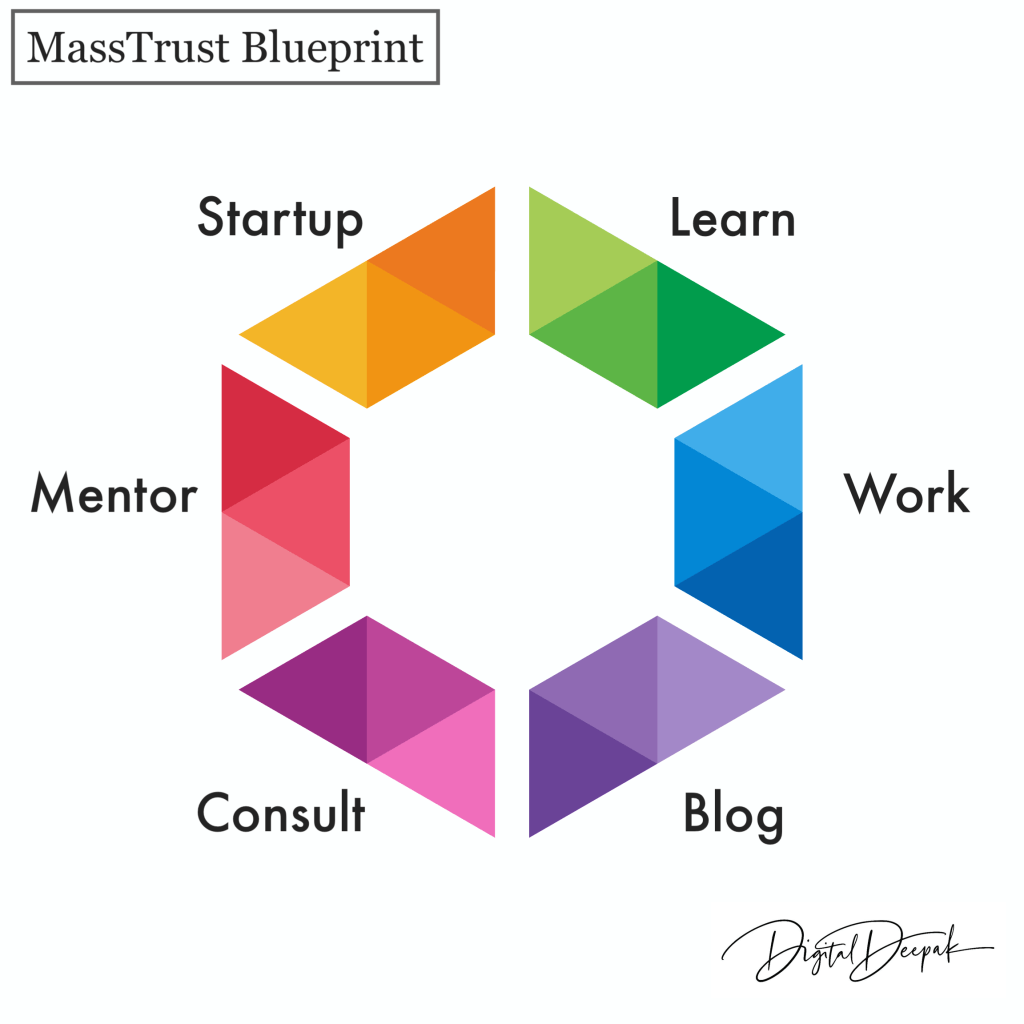
So, this is how a personal brand evolves. In the process of the evolution of a personal brand, we are actually aiming to build trust with a lot of people. Thus the name Mass Trust Framework. As we can see in the figure above, the framework is a never-ending circle. It would only help to continuously go through this evolution because it would help you to grow your personal brand. Learning is a never-ending process and all the other steps follow.
Conclusion
Digital marketing is more about “marketing” and less about digital. You need to start by dedicating yourself completely to one niche and be consistent. You should be the best at what you do!
The key is to continue to evolve. One should be ready to learn everyday, practice what you learn, and teach what you do in order to understand it better, and to do all of this over and over again.
Marketing takes a day to learn. Unfortunately, it takes a lifetime to master.
Philip Kotler
Thank you for taking time out to read till the very end. I hope you enjoyed and learnt a few new things today!
Do not forget to share your thoughts in the comments section!
References
- Attest. 2020. 12 Top Storytelling Marketing Examples: How Brands Tell Stories | Attest Blog. [online]
- Bailey, J. (2020, February 17). Digital marketing vs. traditional marketing: What’s the difference? Retrieved December 24, 2020, from https://99designs.com/blog/marketing-advertising/digital-marketing-vs-traditional-marketing/
- CATT Funnel and Framework from Digital Deepak
- Chaffey, D., Wright, G., & Commentator, E. (2020, October 07). The AIDA model and how to apply it in the real world – examples and tips. Retrieved December 23, 2020, from https://www.smartinsights.com/traffic-building-strategy/offer-and-message-development/aida-model/
- Kanakaraju, D., Pavan, Rout, B., Deepak, Raveendrachary, Hussain, S., . . . Gaur, N. (2017, October 17). Content Marketing 2.0 – How to Plan and Execute an Integrated Digital Marketing Campaign. Retrieved December 23, 2020, from https://digitaldeepak.com/integrated-digital-marketing/

 mangosoul